Economics, Generative AI and the Marketing Services Industry
Economics for Business coursework on generative AI, game theory, labour productivity and externalities in marketing services.
Provenance
Originally submitted in July 2024 as individual coursework for Economics for Business on the Imperial College Business School Executive MBA. The coursework received a distinction.
The original coursework is reproduced below. Its wording, citations, references and figures are preserved; page breaks and running footers are omitted for web reading. Download the original PDF.
BUS197073 – EMBA Economics for Business Individual Coursework
‘The case for providing economics training to all senior managers’
This report presents a case for providing economics training to all senior managers in our organisation. In light of the firm’s strategic investment in AI technologies (WPP PLC, 2024, p. 7), it aims to demonstrate to the board as to the value that knowledge of economics can bring to decision-making, in understanding the second and third order implications of our decisions, towards achieving our long-term vision.
Economics offers practical frameworks that enable us to interpret data effectively, moving beyond instinctive reactions to make informed decisions. For instance, ‘Nash Equilibrium’, helps us analyse competitor behaviour and potential client responses, crucial in devising successful service strategies and fostering innovation. A grasp of economics will also help us to understand how macroeconomic forces and industry trends such as AI impact on ‘Labour Productivity’ and other broader ‘Negative Externalities’. This understanding equips us with the ability to consider the wider economic context in which our business operates, as well as the implications of our actions and decisions on the market, enabling us to navigate challenges more effectively.
However, while economics provides invaluable analytical tools, it's crucial to acknowledge the limitations of economic models. Ethical considerations, social responsibility, and other qualitative factors must also inform responsible leadership and so it should not be the sole basis for our decisions.
Nash Equilibrium for strategic decision making
First, let us look to the recent significant investments in Generative AI by firms across our industry (see Appendix 1: (Jones, 2024)), who are seeking AI’s anticipated productivity and performance benefits (Chui, et al., 2023). Senior leaders might ask: how should firms strategically approach this landscape, particularly when competing for client contracts? Should they integrate AI into their services or maintain traditional offerings?
Nash Equilibrium provides us with a framework to approach these questions. Let's consider a scenario with two firms competing for a contract. Each firm has two strategic options: ‘Offer AI-Enhanced Services’ or ‘Maintain Traditional Services’. For simplicity, we assume that each firm submits their contract bid only once. The matrix in Fig.1 below illustrates the potential outcomes based on the firms’ strategic choices.
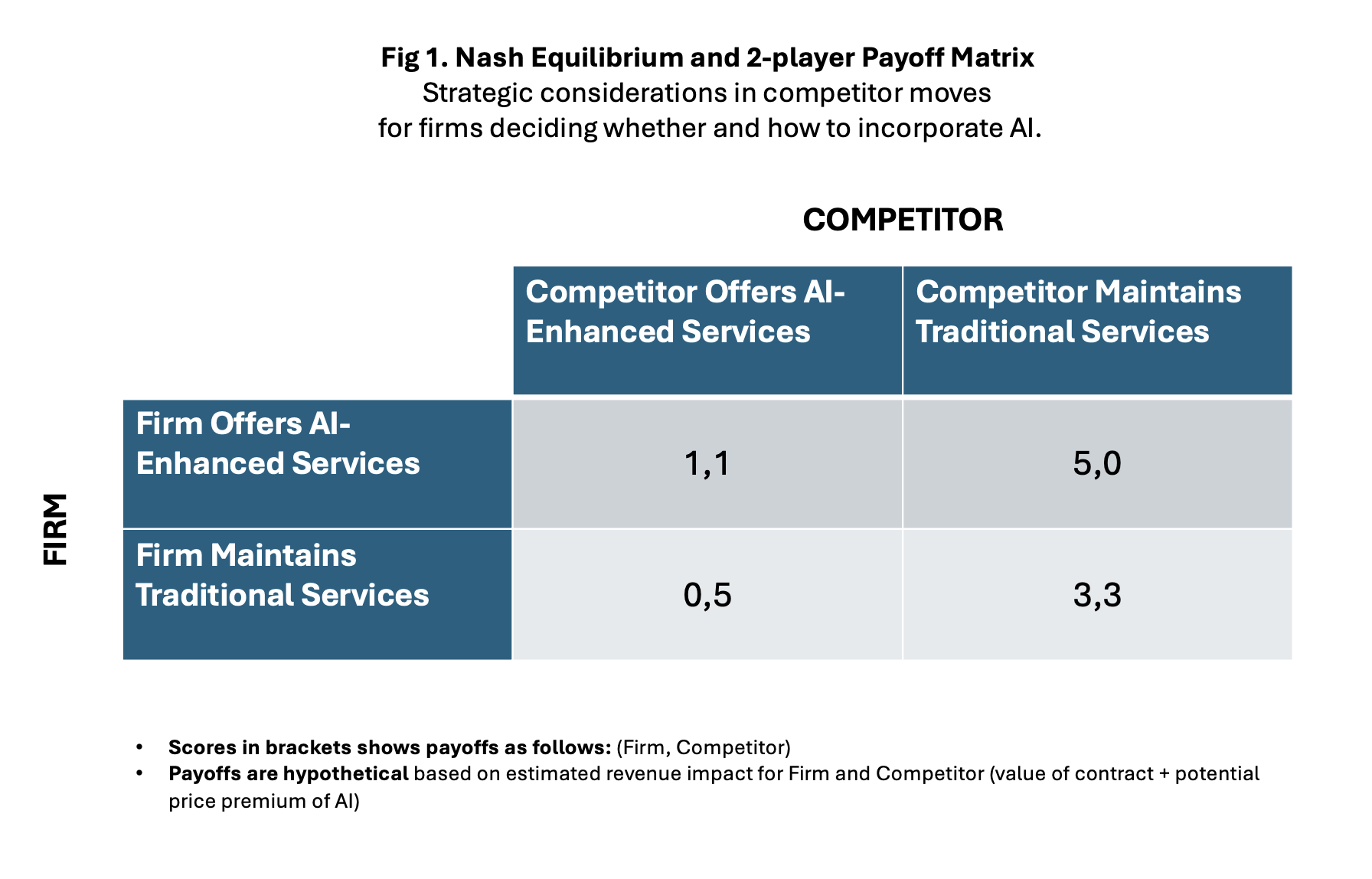
In this hypothetical scenario, each firm is ‘making an optimal decision given the potential response of its rival’ (Begg & Ward, 2019, p. 152). For example, if the competitor offers AI, then the optimal strategy for the firm is to offer AI. Not offering AI would mean the competitor receives a payoff of 5 whilst the firm receives a payoff of 0.
These points of Nash Equilibrium exist when neither firm has an incentive to deviate from their chosen strategy given the other firm’s strategy, as moving would mean losing out in terms of potential payoffs (Nash, 1950). In our scenario above, there are two potential Nash Equilibria: one where both firms offer AI, and another where both firm and competitor choose to maintain traditional services.
The implication for senior management here is in the strategic importance of considering competitor moves. Our scenario shows that differentiation is rewarded - when one firm offers AI and the other doesn't, the innovative firm benefits. The firm offering AI can potentially charge a premium and gain market share through first mover advantages. (Lieberman & Montgomery, 1988, pp. 42, 46). However, if both firms offer AI, they may end up competing more on price, reducing their payoffs. When neither firm offers AI, we assume the payoffs to be lower, as there is less opportunity for differentiation and value creation.
It's important to note that this model operates under simplifying assumptions such as perfect information and perfectly rational actors. From the experience of this author, we know more about our current clients than our competitors do, and managers often make decisions with incomplete data. Further, ‘in every negotiation there are psychological factors concerning the experience and behaviour of the participants that influence the process.’ (Gaffal & Padilla Galvez, 2023, p. 75)
Nonetheless, the Nash Equilibrium framework analysis provides a useful starting point for strategic decision-making. From this fundamental understanding, our team may want to extend the analysis to include the strategies that our client might employ, and the complexity of decision-making based on using ‘information in a dynamic and interactive process’. (Munier & Rullière, 1993, p. 249)
Understanding Labour Productivity in operational efficiency and growth
While Nash Equilibrium provides a framework for strategic decision-making in the face of AI adoption, understanding labour productivity is essential for maximizing returns on such investments and navigating the broader economic implications.
Our recent £250m investment in AI (WPP PLC, 2024, p. 7) reflects a strategic bet on technology to enhance returns of our clients and our own firm’s performance. The promise of AI lies in its potential to boost productivity ( Booth, et al., 2024) (Davenport, et al., 2019) but as yet ‘the evidence is at odds with productivity growth’ (Parteka & Kordalska, 2023, p. 10) (Brynjolfsson, et al., 2017).
So, how can we, as a service-oriented organisation, effectively measure and analyse the impact of AI on our productivity?
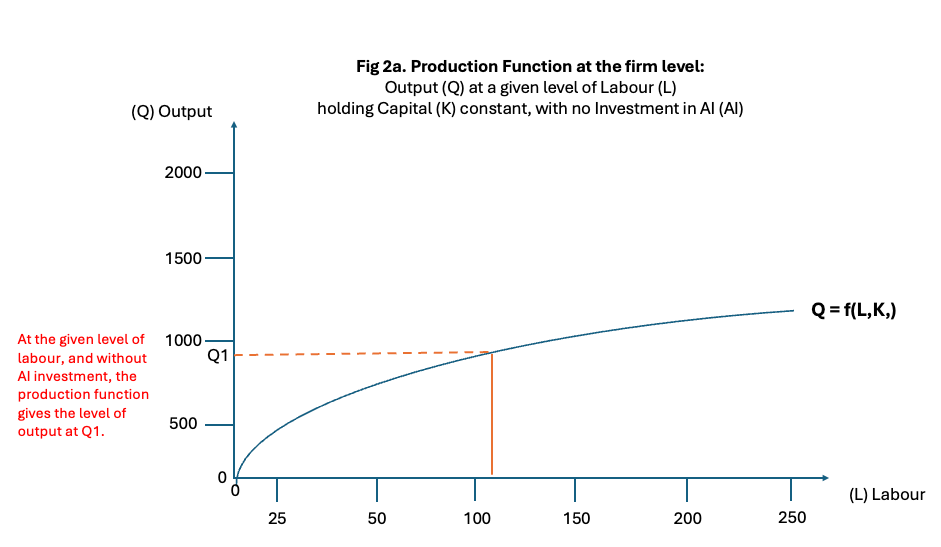
Labour productivity, in our context, is measured by output per hour worked and helps us quantify the impact of AI on employee output such as the number of ad campaigns per graphic designer per month. At the level of the firm, any increase in productivity generally has an expected increase in output – ‘Simply put, productivity is efficiency in production: how much output is obtained from a given set of inputs’ (Syverson, 2011, p. 329), and this relationship between the inputs of productivity (labour, capital and technology) can be modelled through the Production Function.
Fig 2a. describes a hypothetical production function for our firm before AI integration, showing the relationship between the number of ad campaigns (Q) that can be delivered by a certain number of graphic designers (L) and a certain number of computers (K).
Let us then introduce AI, assuming it increases labour productivity. In Fig 2b. the new production function is defined as Q = f(L,K,AI) where AI is the technology input (investment in AI tools and platforms).
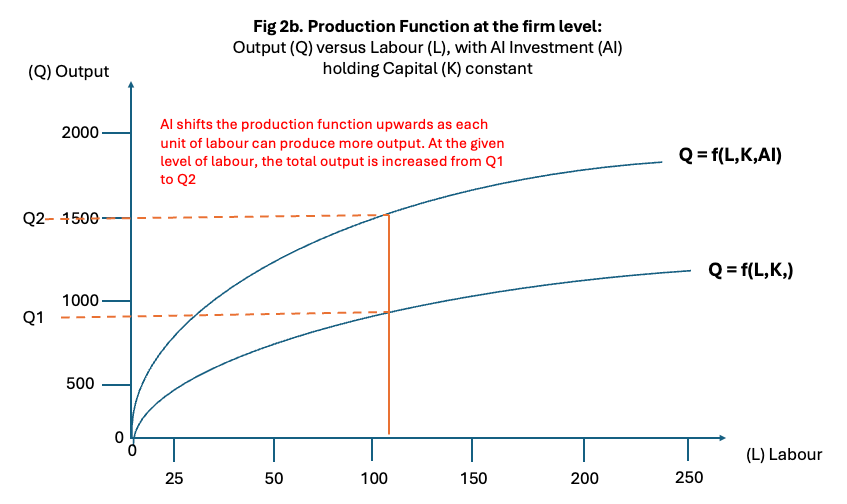
The production function shifts upwards and vertical distance between the two curves at a given level of labour input represents the increase in output due to the introduction of AI: each graphic designer can now deliver more ad campaigns. The portion of output not explained by the amount of graphic designers, computers or AI inputs used in production is measured by Total Factor Productivity (TFP) – that is, a measure of how efficiently these inputs are being used to produce output.
There are challenges in measuring productivity for service-based industries. The Office for National Statistics (ONS) measures labour productivity as output per hour, where ‘output’ is Gross Value Added (GVA) (Office for National Statistics, 2020). Unlike the quantifiable units and heterogenous goods in manufacturing sectors, how do you measure the GVA of a creative workshop? Plus, our services are often customised – a website for a beauty brand will be different to one for a bank.
Our firm's AI investments also happen within a broader economic context. Widespread AI adoption across our industry (Jones, 2024) can have significant implications for aggregate labour productivity and economic growth (Acemoglu & Restrepo, 2020); (Coyle & Jones, 2024).
TFP is also considered a measure of an economy's long-term technological dynamism and innovation (Hulten, 2001). In other words, if an economy can produce more output from the same inputs, it has experienced TFP growth. In Fig 3. the aggregate production function Y = A * f(L, K, AI), where Y is GDP, ‘A’ represents total factor productivity (influenced by AI). The other variables remain the same. An increase in "A" due to AI adoption shifts the function upward, indicating higher potential output.
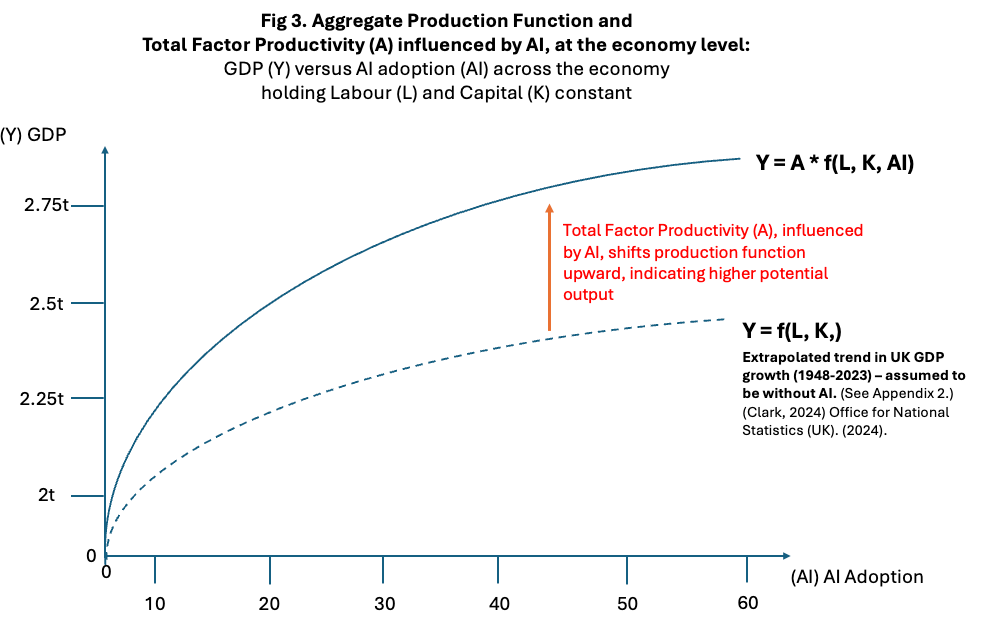
By analysing the impact of AI investments on labour productivity and specifically to the number and quality of campaigns we deliver to our clients, our senior managers can make informed strategic decisions on whether to continue AI investment or reallocate the funds to increase headcount, anticipate competitor behaviour in AI adoption to see if we can gain a first mover advantage, and as we shall explore in the next section, proactively address potential economy-wide implications.
Negative Externalities and societal implications.
While AI promises significant gains in labour productivity, senior managers must also be aware of potential negative externalities, that is, costs that are suffered by a third party as a result of an economic transaction (Begg & Ward, 2019, p. 200). Failing to consider these broader societal impacts could lead to unintended consequences that harm the firm's long-term sustainability and reputation.
In the context of AI, the concern of job displacement is a prime example. Job losses could impose costs on the displaced workers and potentially the broader community, especially if the displaced workers are unable to find new jobs quickly (Bessen, 2018). Fig 4. illustrates how AI adoption can lead to reduced demand for certain types of labour, resulting in lower employment and wages in affected job categories.
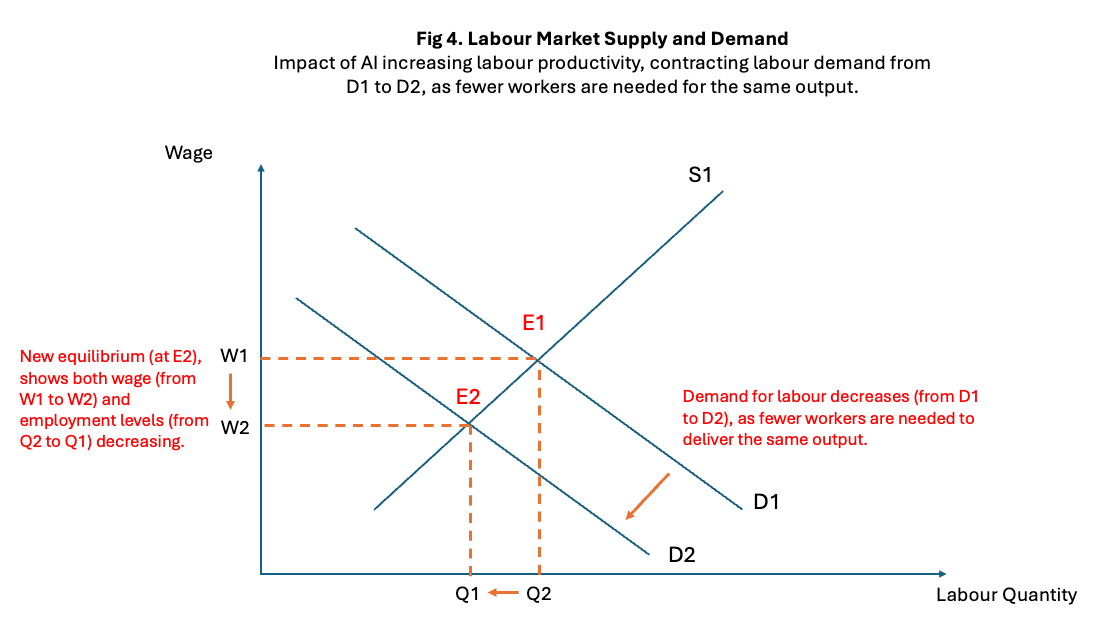
Extrapolating this in aggregate, increased use of AI could also potentially worsen income inequality, as the benefits of AI are likely to go disproportionately to high-skilled workers and capital owners where ‘change favoring one type of worker can reduce the real wages of another group.’ (Acemoglu & Autor, 2010, p. 4).
Fig 5 below illustrates the divergence in costs and benefits to firms and society.
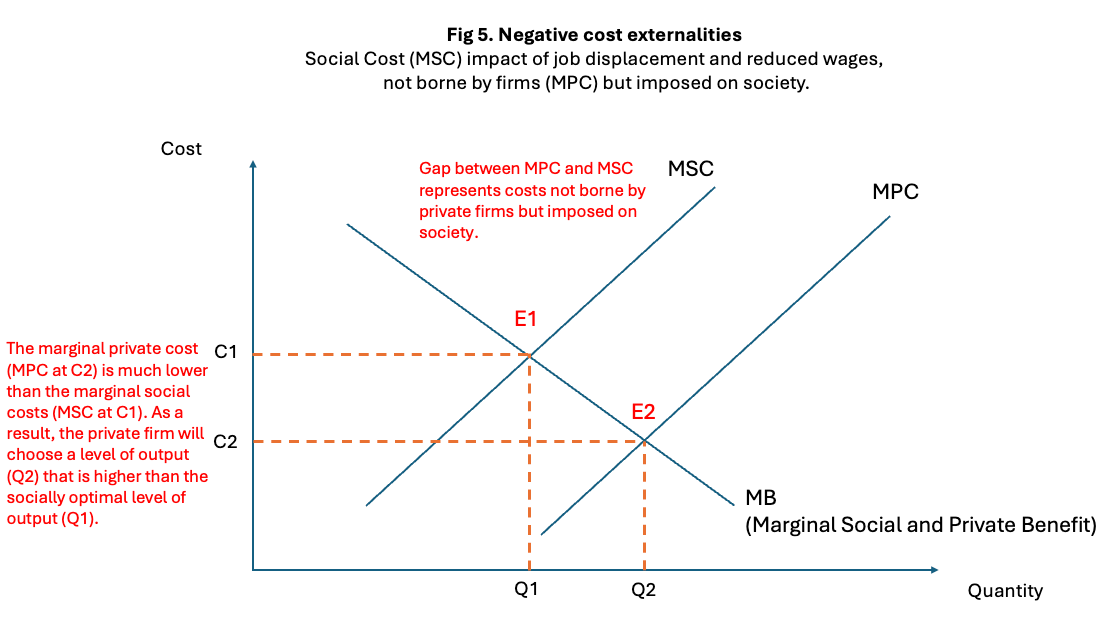
So how can firms like ours mitigate these negative externalities? Can we upskill or retrain those employees whose roles are at risk of being displaced by AI? (Coyle & Jones, 2024). Reskilling implies additional costs which the firm would bear, impacting profitability and according to a recent report from the World Economic Forum, ‘Companies rank AI and big data 12 places higher in their skills strategies than in their evaluation of core skills, and report that they will invest an estimated 9% of their reskilling efforts in it…’ (World Economic Forum, 2023).
Government can intervene to help reduce the wider social impact of unemployment, which includes reduced tax revenue, as intuitively, there will be fewer people contributing to income tax together with an additional strain on the social welfare system to support the unemployed.
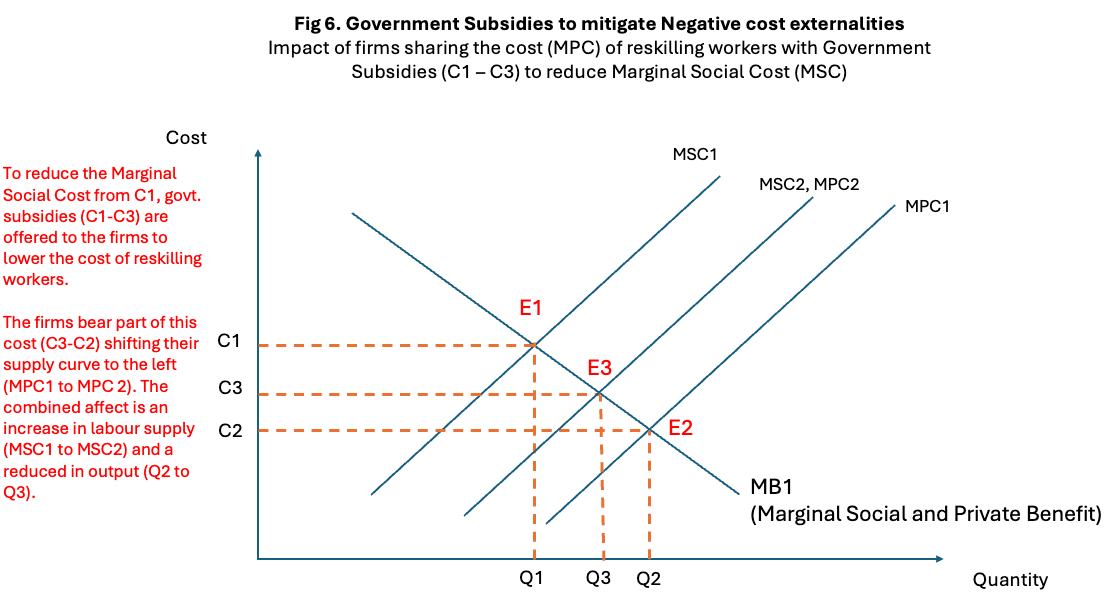
Fig 6 below illustrates how firm and government might share the burden to reduce the societal cost of job displacement due to AI. For example, government offers subsidies to firms to promote the reskilling of workers in AI technologies, effectively reducing the cost of training for firms, leading to an increase in the supply of labour. Choosing to take the subsidy, the price for the firms is the opportunity cost of a reduction in output to meet this supply of labour.
It's also crucial to consider the demand-side effects of AI-driven productivity gains. As James Bessen argues, if AI leads to lower prices and increased output, it can stimulate demand for products and services, potentially creating new job opportunities that offset some of the displacement effects. (Bessen, 2018)
Understanding both positive and negative externalities is essential for holistic decision making. By proactively addressing potential negative externalities through investments in our employees and collaborating with policymakers we can harness the transformative power of AI for more sustainable long-terms strategies.
In conclusion, equipping our senior managers with a good understanding of economic principles is essential. As our industry navigates the complexities of AI adoption, the ability to analyse competitor behaviour using game theory (Nash Equilibrium), optimize resource allocation for maximum productivity, and anticipate and mitigate potential societal impacts will be critical to our success in the long term.
Investing in economics training is not just an investment in our managers, it's an investment in our firm's ability to navigate uncertainty, make strategic decisions, and thrive in a rapidly evolving marketplace. This report has highlighted just a few key areas where economic thinking can make a tangible difference, and the board should consider the long-term value of incorporating economics training into our leadership development programs.
APPENDIX 1
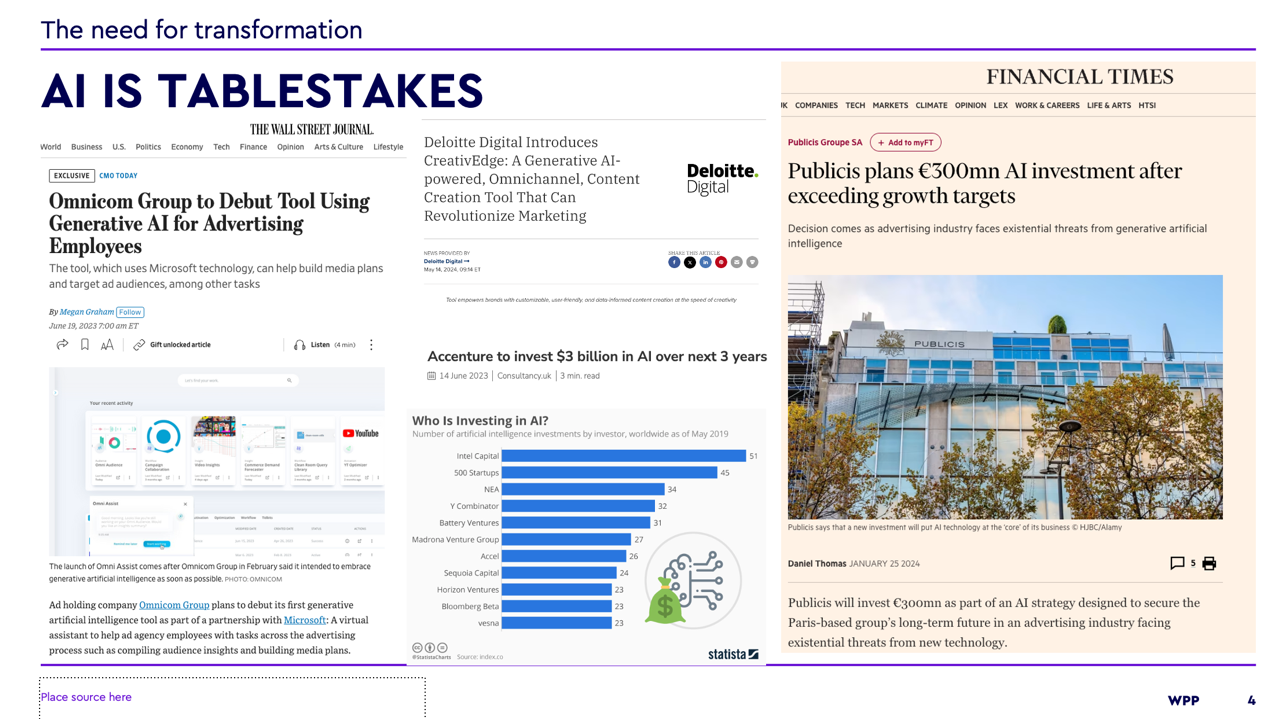
Source: (Jones, 2024)
APPENDIX 2
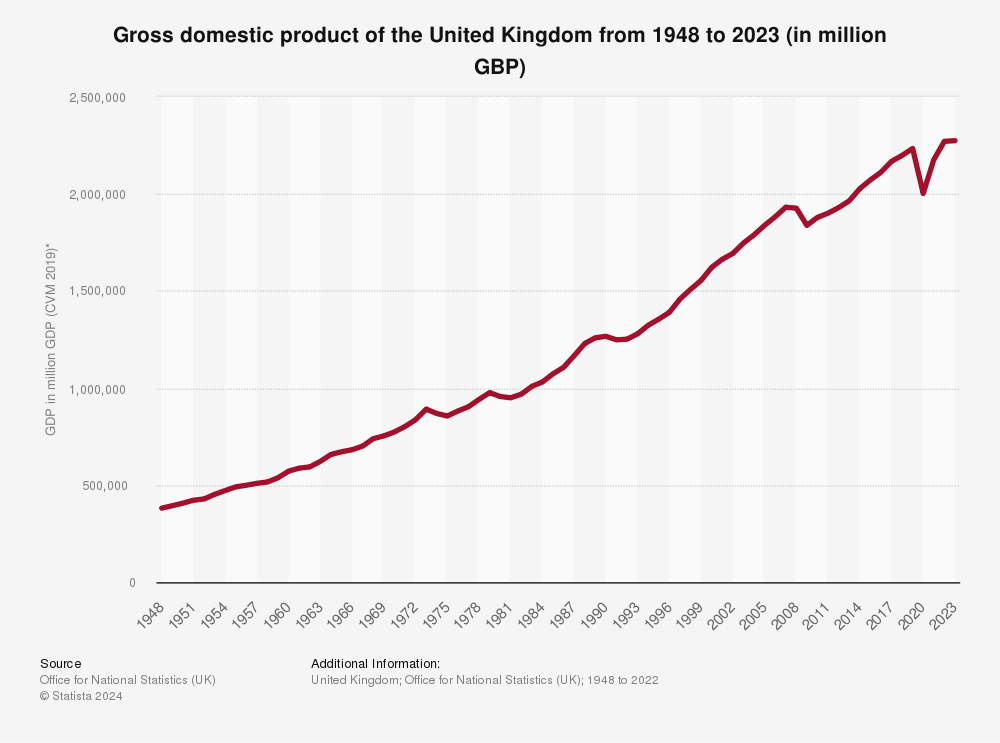
Source: (Clark, 2024) Office for National Statistics (UK). (2024). Gross domestic product of the United Kingdom from 1948 to 2023 (in million GBP). Statista. Statista Inc.. Accessed: July 12, 2024. https://www-statista-com.iclibezp1.cc.ic.ac.uk/statistics/281744/gdp-of-the-united-kingdom/
Works Cited
Booth, B., Donohew, J., Wlezien, C. & Wu, W., 2024. Generative AI fuels creative physical product design but is no magic wand. [Online] Available at: https://www.mckinsey.com/capabilities/mckinsey-digital/our-insights/generative-ai-fuels-creative-physical-product-design-but-is-no-magic-wand [Accessed July 2024].
Acemoglu, D. & Autor, D., 2010. Skills, Tasks and Technologies: Implications for Employment and Earnings*. In: O. Ashenfelter & D. Card, eds. HANDBOOK OF LABOR ECONOMICS, VOL 4B. s.l.:North Holland, p. 1130.
Acemoglu, D. & Restrepo, P., 2020. Robots and Jobs: Evidence from US Labor Markets. Journal of Political Economy, 22 April, 128(6), pp. 2188-2244.
Begg, D. & Ward, D., 2019. Economics for Business. Sixth Edition.. London: McGraw Hill.
Bessen, J., 2018. AI and Jobs: the role of demand. [Online] Available at: https://www.nber.org/papers/w24235 [Accessed 13 July 2024].
Brynjolfsson, E., Rock, D. & Syverson, C., 2017. Artificial Intelligence and the Modern Productivity Paradox: A Clash of Expectations and Statistics. [Online] Available at: https://www.nber.org/papers/w24001 [Accessed 13 July 2024].
Chui, M. et al., 2023. The economic potential of generative AI. The next productivity frontier.. [Online] Available at: https://www.mckinsey.com/ [Accessed June 2024].
Clark, D., 2024. Office for National Statistics (UK). (2024). Gross domestic product of the United Kingdom from 1948 to 2023 (in million GBP). [Online] Available at: https://www-statista-com.iclibezp1.cc.ic.ac.uk/statistics/281744/gdp-of-the-united-kingdom/ [Accessed July 2024].
Coyle, D. & Jones, R., 2024. Can digital innovation, including AI, improve productivity growth?. [Online] Available at: https://www.economicsobservatory.com/can-digital-innovation-including-ai-improve-productivity-growth [Accessed July 2024].
Davenport, T., Guha, A., Dhruv, G. & Bressgott, T., 2019. How artificial intelligence will change the future of marketing. Journal of the Academy of Marketing Science, October, Volume 48, pp. 24-42.
Gaffal, M. & Padilla Galvez, J., 2023. GálvezDynamics of Rational NegotiationGame Theory, Language Games and Forms of Life. Cham: Springer.
Hulten, C. R., 2001. Total Factor Productivity. A Short Biography. In: New Developments in Productivity Analysis. Chicago: University of Chicago Press.
Jones, D. J., 2024. WPP Open. The Future Operating System for BAT, Starting Today. London: WPP.
Lieberman, M. B. & Montgomery, D. B., 1988. First-mover advantages. Strategy Management Journal, Volume 9, pp. 41-58.
Munier, B. R. & Rullière, J. L., 1993. Are game theoretic concepts suitable negotiation support tools? From Nash equilibrium refinements toward a cognitive concept of rationality.. Theory and Decision, Issue 34, pp. 235-253.
Nash, J. F., 1950. The Bargaining Problem. Econometrica, April, Vol 18(2), pp. 155-162.
Office for National Statistics, 2020. Labour productivity, UK: October to December 2019, s.l.: s.n.
Parteka, A. & Kordalska, A., 2023. Artificial intelligence and productivity: global evidence from AI patent and bibliometric data. The International Journal of Technological Innovation, Entrepreneurship and Technology Management, July.Volume 125.
Syverson, C., 2011. What Determines Productivity?. Journal of Economic Literature, June, 49(2), pp. 326-365.
Vaitilingam, R., 2024. The UK’s productivity gap: what did it look like twenty years ago?. [Online] Available at: https://www.economicsobservatory.com/the-uks-productivity-gap-what-did-it-look-like-twenty-years-ago [Accessed July 2024].
World Economic Forum, 2023. The Future of Jobs Report 2023. [Online] Available at: https://www.weforum.org/publications/the-future-of-jobs-report-2023/ [Accessed 13 July 2024].
WPP PLC, 2024. WPP Annual Report 2023, London: WPP PLC.
Related reading — outside the original coursework
The Johor–Singapore growth story considers a later hypothesis about marketing operations and content-delivery businesses, including the risk that AI reduces prices faster than costs.